ABOUT This is a Lightning Component that plays a sound effect. It can be used on Flow Screens and Lightning Pages. In order to play a sound, you have to upload the sound file as a Static Resource and then enter the name of the file to the “Sound File” parameter.
PARAMETERS Sound File – Enter the name of the sound file.
CONSIDERATIONS This component loads the sound file from Static Resources and plays it. So it is recommended to use smaller file sizes, otherwise it might take some time to load the file.
HOW TO USE 1- Upload the sound file as a Static Resource.
2- Add “SoundCMP” to your Flow Screen. 3- Enter the name of the sound file to the parameter called “Sound File”.
https://unofficialsf.com/wp-content/uploads/2022/09/largeUCSF-300x133.png00Yumi Ibrahimzadehttps://unofficialsf.com/wp-content/uploads/2022/09/largeUCSF-300x133.pngYumi Ibrahimzade2020-03-06 07:25:082020-03-06 07:39:29A Flow Screen Component that plays sounds
https://unofficialsf.com/wp-content/uploads/2022/09/largeUCSF-300x133.png00Tamar Erlichhttps://unofficialsf.com/wp-content/uploads/2022/09/largeUCSF-300x133.pngTamar Erlich2020-03-02 09:59:152020-03-02 09:59:17Update N Records in Flow Without a Loop by Jessie Rymph
The first post in a new series on the Salesforce admin blog demonstrates a novel way to launch auoto-launched flows from a formula field on a report. This has several very interesting use cases Check it out
https://unofficialsf.com/wp-content/uploads/2022/09/largeUCSF-300x133.png00Tamar Erlichhttps://unofficialsf.com/wp-content/uploads/2022/09/largeUCSF-300x133.pngTamar Erlich2020-02-27 06:00:192020-02-27 06:00:20Launch a flow from a formula field
Lightning Flow already empowers you to declaratively automate your business processes within Salesforce. But what if your business processes require integrations between Salesforce and other non-Salesforce services? Chances are that customer service agents who use Salesforce to track and resolve support cases would also need to access information from and/or submit changes to another backend system. Or perhaps you want a Flow to create a new record in Salesforce as well as post a message in Slack to notify the team. These are scenarios where you can leverage External Services to extend the ability of Flow to automate processes beyond Salesforce!
External Services provides a declarative way to access external business processes, whether they are proprietary APIs, public APIs, or other Salesforce APIs:
For any REST API that you want available as a callout from Lightning Flow, you just need to register the OpenAPI 2.0 specification for that API, so that it will be available as an action in Flow.
Configuring Flow to Integrate with an External Service
To support this integration, you just need to provide Salesforce with the following information:
Named Credentials
Where to configure this: Setup -> Named Credentials
What these configurations tell Salesforce: Where is the external service being hosted (domain URL), and what credentials do we need to send for authentication?
External Services:
Where to configure this: Setup -> External Services
What these configurations tell Salesforce: Where the OpenAPI 2.0 specification is located (relative to the domain URL of the Named Credential), and/or what the API specification is. The specification describes what API callouts Salesforce can make to the external service.
Flow Action:
Where to configure this: Setup -> Flow
What these configurations tell Salesforce: Which action / callout you want to make to the external API, what input parameters you want to send, and what variable you want to use to store the response.
Example
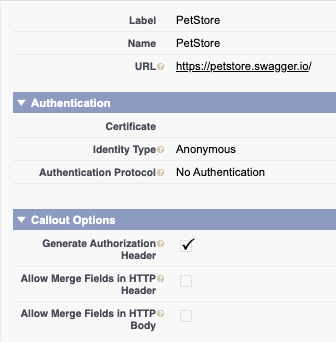
This example shows how to the register the OpenAPI 2.0 specification for the Swagger PetStore API, as well as configure a callout to the PetStore API in Flow:
Named Credential:
External Service:
Flow – Add “findPetsByStatus” action:
Flow – Configure Input Parameters and Store Response:
Learn More
Here are some more resources for you to learn more about External Services:
https://unofficialsf.com/wp-content/uploads/2022/09/largeUCSF-300x133.png00Liz Skaateshttps://unofficialsf.com/wp-content/uploads/2022/09/largeUCSF-300x133.pngLiz Skaates2020-02-13 17:58:592020-02-20 11:21:25Extend the Power of Flow with External Services
When our org migrated to Lightning, we were faced with an interesting issue: we had many task record types and in order to enable our end users to create tasks from the activity composer, we had to create a different quick action for each task record type. The result wasn’t pretty
Too many tabs
Our users wanted a simple button where they could create a task with one click and be able to select the task record type. When I set out to build the solution, I started by using a Get Records element to query the record type object but soon realized that I can’t filter this list based on the record types available to the current user.
I was able to provide a nice solution using the new invocable action and quickChoice component found here on this site. I used the Get Record Type Info by Object action to generate a list of record types available to the current user. Then I fed the record type labels and Ids into the Quick Choice component. Finally I created the task and used the Navigate to Record action to open the new task in edit mode.
Get the available record typesYou need to check this box to store the output valueThe new task Id is fed into this actionAnd this is the completed flowHere is the end user experience
https://unofficialsf.com/wp-content/uploads/2022/09/largeUCSF-300x133.png00Tamar Erlichhttps://unofficialsf.com/wp-content/uploads/2022/09/largeUCSF-300x133.pngTamar Erlich2020-02-10 12:18:322020-02-13 07:56:44Flow Use Case – New Task Button with picklist for selecting the record type
GORAV SETH demonstrates how you can use the new flow before save trigger combined with duplicate rules to prevent creation of duplicate junction object records. Check it out
https://unofficialsf.com/wp-content/uploads/2022/09/largeUCSF-300x133.png00Tamar Erlichhttps://unofficialsf.com/wp-content/uploads/2022/09/largeUCSF-300x133.pngTamar Erlich2020-02-10 12:13:032020-02-10 17:19:28Preventing duplicate junction object records by GORAV SETH
This action can be used to generate a list of record types for a specific object. This can be useful when you would like to present a record type selector to the user. Can be used as inputs to the QuickChoice by setting Input Mode to “Dual String Collections”. Pass in one output collection for Labels and one for the underlying values
Inputs
Attribute
Type
Description
Object Name
String
API name of the target object example “Task” or “MyObject__c”
ignoreMasterRecordType
Boolean
If “on” then “Master” will not be added to the list of record types
onlyReturnActiveRecordTypes
Boolean
If “on” then only active record types will be added to the list
onlyReturnRecordTypesAvailableToCurrentUser
Boolean
If “on” then only record types available to the current user will be returned
Outputs
Attribute
Type
Description
errors
String
captures details of any error that occurred
recordTypeIds
String
Ids of the records types.
recordTypeNames
String
Names of the record types.
defaultRecordTypeName
String
defaultRecordTypeId
String
Installation
1.1 Unmanaged 5/13/21 – Added outputs for the default Record Type
https://unofficialsf.com/wp-content/uploads/2022/09/largeUCSF-300x133.png00Tamar Erlichhttps://unofficialsf.com/wp-content/uploads/2022/09/largeUCSF-300x133.pngTamar Erlich2020-01-19 09:13:412021-05-13 15:14:05Get Record Type Info by Object – Flow Action
Narender Singh form ForcePanda wrote a two blog series about using map collections in flows. The second blog makes good use of the new generic sObject support in flows coming in the Spring ’20 release
https://unofficialsf.com/wp-content/uploads/2022/09/largeUCSF-300x133.png00Tamar Erlichhttps://unofficialsf.com/wp-content/uploads/2022/09/largeUCSF-300x133.pngTamar Erlich2019-12-18 05:51:502019-12-18 06:56:59How to create a Map collection in Flows by Narender Singh
https://unofficialsf.com/wp-content/uploads/2022/09/largeUCSF-300x133.png00Tamar Erlichhttps://unofficialsf.com/wp-content/uploads/2022/09/largeUCSF-300x133.pngTamar Erlich2019-12-11 12:06:532019-12-11 12:06:54Creating a unique collection in flow by GORAV SETH
A common need in Flows is to be able to redirect the user to a new record that may have been created in the Flow. This new Lightning Flow Action can be used to redirect the user to the specified record in either View Mode or Edit Mode.
https://unofficialsf.com/wp-content/uploads/2022/09/largeUCSF-300x133.png00Eric Smithhttps://unofficialsf.com/wp-content/uploads/2022/09/largeUCSF-300x133.pngEric Smith2019-09-19 12:29:112019-09-19 12:38:48Navigate to a Record in View or Edit Mode at the end of a Flow